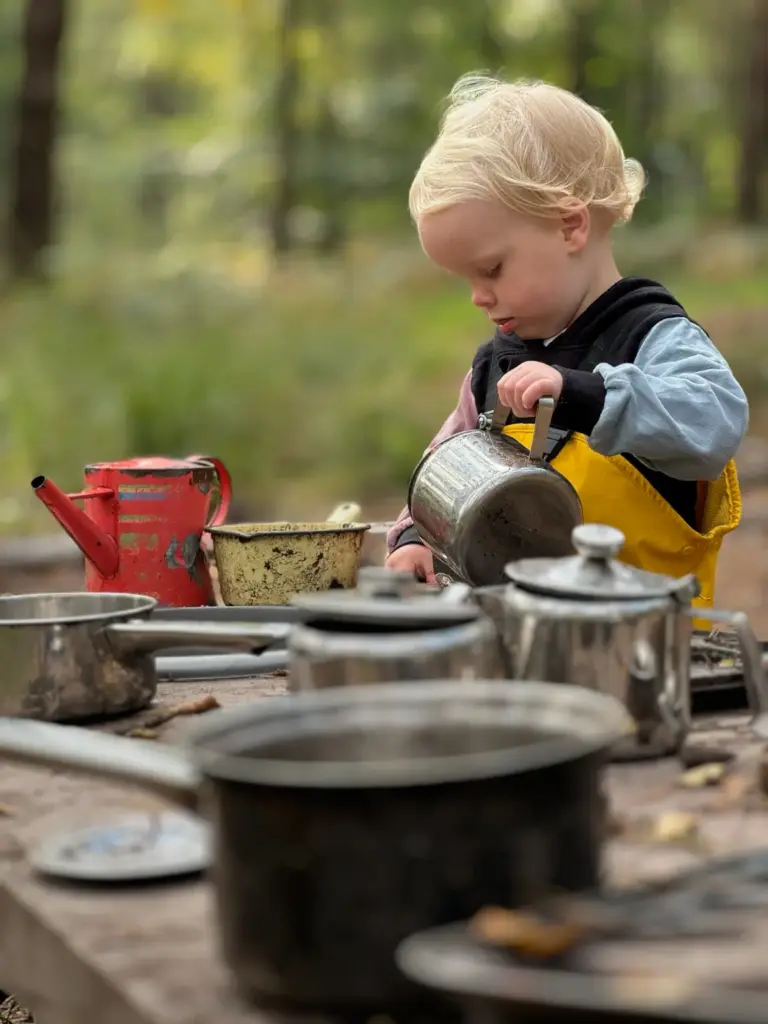
There is something uniquely powerful about the way young children experience the natural world. A muddy puddle is rarely just a puddle; it becomes something to jump in, investigate, stir with a stick or transform into an imaginary potion. A fallen log can be a balance beam one moment and a pirate ship the next, while a handful of autumn leaves can prompt questions about colour, seasons, insects and trees without an adult needing to plan a formal lesson.
At A Touch of the Wild, we have long seen how much children can gain from regular, meaningful time outdoors. Nature provides a constantly changing environment in which children are encouraged to move, explore, solve problems, take manageable risks and follow their own curiosity. This October, the importance of those experiences has been brought into the national conversation following a new announcement from The Royal Foundation Centre for Early Childhood.
The Princess of Wales has commissioned new work exploring the role of nature-rich environments in early childhood and, in particular, how time spent in nature can support babies and young children as they develop socially and emotionally. The announcement followed a visit to Cornwall and reflects a growing interest in the relationship between the natural world, early development and wellbeing.
One of the most striking findings shared alongside the announcement came from polling commissioned by the Centre. It found that 84% of parents believe spending time in nature supports their child’s wellbeing and development, yet only 33% said their child spends time in nature every day. Most parents also said they would like their children to have more opportunities to experience nature through childcare and education.
For those of us working in outdoor education, those figures will probably come as little surprise. Many parents instinctively understand that being outside is good for children, but modern family life can make regular, unhurried time in nature difficult to achieve. Busy working weeks, childcare commitments, screen time, weather and the simple logistics of everyday life can all play a part. That is why early years settings that make outdoor learning part of everyday life can be so valuable.
Learning through real experiences
When people first encounter Forest School or outdoor kindergarten, it can sometimes appear as though the children are simply playing. In reality, that play is doing a great deal of work.
Young children learn by doing, experimenting and repeating. When a child is deciding how to cross a muddy patch without losing a welly, they are solving a problem. When two children work together to carry a branch, they are communicating and negotiating. When a tower of sticks collapses and they choose to rebuild it, they are learning perseverance. Climbing, balancing, digging, pouring and carrying all help to develop coordination and physical confidence, while imaginative games encourage language, creativity and social development.
The woodland lends itself particularly well to this kind of learning because it is not a fixed or predictable environment. It changes from day to day and season to season. One morning the ground may be crisp with frost; another day it may be soft with mud. Leaves fall, buds appear, insects emerge, fungi come and go, and familiar places can look completely different after a night of heavy rain.
For a young child, these changes provide an endless source of questions. Why has the puddle disappeared? Where do worms go when the ground is dry? Why are some leaves still green when others have turned orange? Who has made those tracks in the mud? Rather than learning about nature only through pictures or books, children are able to encounter it directly and begin making connections for themselves.
The importance of time
One of the most valuable things outdoor learning can offer children is something that has become increasingly scarce in modern life: time.
Time to notice, time to wonder, time to become absorbed in an idea and time to try something more than once. Children do not always need an adult to step in with an answer. Often, some of the richest learning happens when they are allowed to investigate a problem, test an idea and discover the outcome for themselves.
This is particularly important in the early years, when confidence and independence are still developing. A small physical challenge, such as balancing along a log or climbing a gentle slope, can feel enormously significant to a child. With appropriate support and supervision, they can assess what they are capable of, work out how to approach the challenge and experience the satisfaction of succeeding through their own efforts.
Those moments matter because confidence is rarely built through being told that we are capable. It grows through experience.
Children value nature too
Recent findings from Natural England’s Children’s People and Nature Survey also highlight the importance of the outdoors from the child’s perspective. The survey found that 93% of children and young people aged 8 to 15 agreed that being in nature makes them very happy. Yet only 35% reported having outdoor lessons, other than PE, every day or most days during term time.
Perhaps even more tellingly, among children who said there was more nature around their school than in the previous year, 72% said that this made them enjoy school more.
Of course, older children and early years children have different developmental needs, but the wider message is worth paying attention to. Nature is not simply something adults think children should value. Children themselves repeatedly tell us that being outdoors contributes to how they feel.
Building a relationship with the natural world
There is another reason regular access to nature matters. If we hope that children will grow up caring about the environment, they need opportunities to develop a genuine relationship with it.
It is difficult to care deeply about something that feels distant or abstract. A child who regularly notices the birds that visit a woodland, watches the seasons change on a familiar tree or learns where minibeasts hide begins to build a sense of connection. Over time, those places become familiar. Children notice when something has changed, recognise favourite spots and begin to understand that they are part of a much larger living environment.
That relationship cannot always be taught through a worksheet. It develops through repeated, meaningful experience.
At Wildlings Forest Kindergarten, this is woven into everyday life. Children have the space to explore, move, create, imagine and learn outdoors, with the woodland itself becoming part of their learning environment. At Wild Tots, younger children and their grown-ups can begin that relationship together through play, discovery and shared time outside.
Planned activities have their place, but some of the most memorable learning often begins with something completely unexpected: a feather on the ground, a strangely shaped fungus, a snail slowly crossing the path or a question nobody had anticipated.
Making nature part of childhood
The renewed national focus on nature and early childhood is encouraging because it recognises something many families and educators already understand: outdoor experiences are not simply an enjoyable extra. They can play an important role in children’s development, wellbeing and sense of connection with the world around them.
That does not mean every family needs access to acres of woodland or elaborate outdoor adventures. Nature can become part of childhood in much smaller ways too. It might mean slowing down on the walk home to look at a spider’s web, collecting autumn leaves, listening for birds, jumping in puddles or turning over a log and carefully discovering what lives underneath.
What matters is that children have the opportunity to experience the natural world regularly enough for curiosity to grow into familiarity and familiarity to grow into connection.
The new Royal Foundation project will no doubt add further research and attention to this area over the months ahead. Here in our Devon woodland, we are pleased to see nature-based early education receiving the recognition it deserves.
Childhood is full of important firsts: the first time a child climbs a log without help, recognises a bird call, toasts something over a fire or discovers a tiny creature beneath a leaf. These experiences can appear small, but together they help shape confidence, curiosity and a lifelong relationship with the outdoors.
If you would like your child to experience more of their early years in nature, you can find out more about Wildlings Forest Kindergarten and Wild Tots at A Touch of the Wild.