As September approaches, many parents begin wondering whether their child is ready for nursery, pre-school or primary school.
Can they recognise their name? Should they know their letters? Can they count to ten? Do they need to be able to write before they begin?
It is completely understandable to have these questions. Starting a new educational setting is a significant milestone for the whole family.
However, school readiness is about much more than academic skills.
Before children can concentrate on phonics, writing and numbers, they need strong foundations in communication, physical development, confidence, relationships and emotional wellbeing.
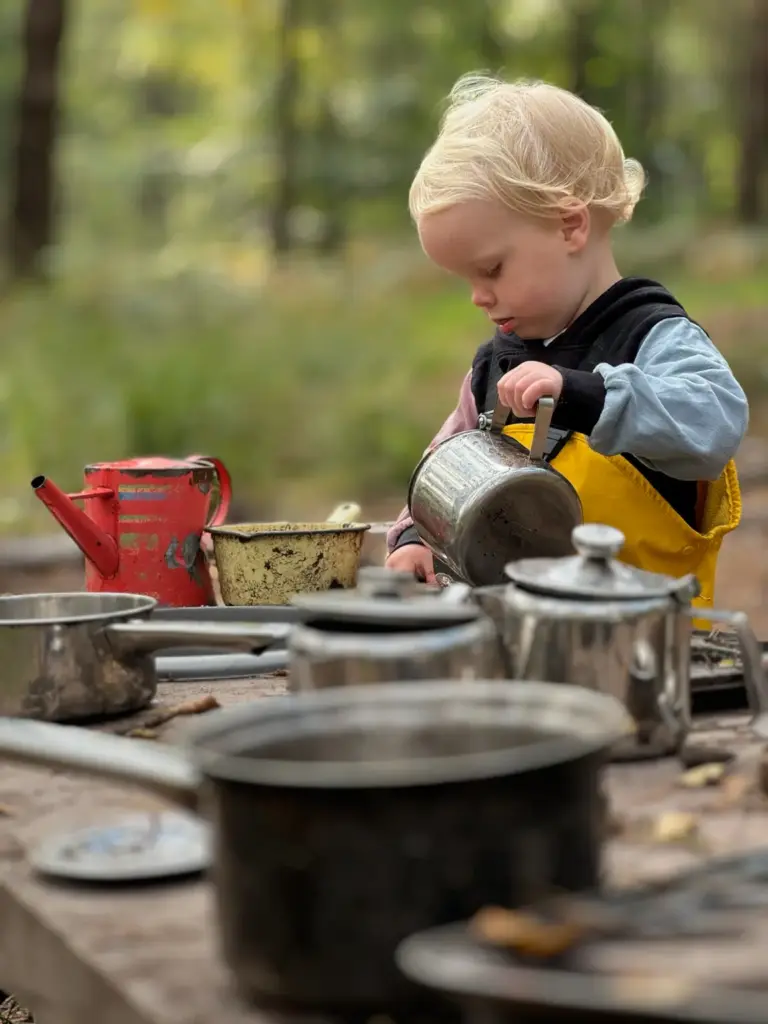
These skills do not have to be developed through worksheets or formal lessons. Many of them grow naturally through play, everyday experiences and time spent outdoors.
At A Touch of the Wild, we see how a nurturing Forest Kindergarten environment can help children develop the independence, curiosity and resilience they need for their next steps.
What does school readiness really mean?
School readiness does not mean turning a young child into a miniature school pupil before their time.
Every child develops at their own pace, and no two children will begin nursery or school with exactly the same abilities or experiences.
Being ready to learn is often about having the confidence and practical skills to participate in the day.
This may include being increasingly able to:
- Communicate needs and feelings
- Listen to a short explanation
- Take turns and play alongside others
- Manage simple personal-care routines
- Attempt tasks independently
- Ask an adult for help
- Cope with small changes or setbacks
- Move confidently and safely
- Become interested in stories, words and numbers
- Separate from a parent or carer with sensitive support
These abilities provide foundations on which later academic learning can be built.
Communication comes before perfect pronunciation
Children do not need to arrive at nursery or school using long, perfectly formed sentences.
What matters is that they are developing ways to communicate with the people around them.
Outdoor play creates countless reasons to talk and listen.
A child might explain how they want to build a den, describe a minibeast they have discovered or ask a friend to pass them a stick. They may listen to instructions before using a tool, join in with a campfire song or tell a story inspired by the woodland.
These are meaningful communication experiences.
Children are more likely to use new language when it relates to something that has captured their interest. Words such as slippery, enormous, underneath, balance, flutter and shelter become easier to understand when children can connect them to a real experience.
Independence grows through everyday opportunities
Independence does not mean expecting young children to manage everything alone.
It means giving them appropriate opportunities to try, while knowing that a trusted adult is nearby to support them.
In an outdoor setting, children can practise making choices, looking after their belongings and completing manageable tasks.
They might carry their own bag, choose the materials they need, pour a drink, put on a glove or decide which activity to explore.
These small moments matter.
When adults allow children enough time to attempt a task before stepping in, children begin to experience themselves as capable. Their movements may not be quick or tidy, but the process helps them build confidence.
A child who is accustomed to hearing “Have a go” rather than “Let me do that” gradually develops greater trust in their own abilities.
Learning how to manage feelings
Starting nursery or school can bring excitement, uncertainty and strong emotions.
Children may need to cope with separating from familiar adults, following new routines, sharing resources and waiting for attention. These are significant demands for a young child.
Emotional readiness does not mean that a child never becomes worried, frustrated or upset.
It means they are beginning to recognise feelings and discovering that difficult moments can be managed with support.
At Forest Kindergarten, children encounter natural opportunities to practise this.
A tower might fall down. Another child may be using a favourite tool. A planned activity may change because of the weather. A child may feel nervous about trying something new.
Sensitive adults help children name what they are experiencing, find possible solutions and understand that feelings pass.
Over time, children begin to develop their own strategies. They may ask for help, take a pause, try again or seek reassurance from someone they trust.
Building relationships through shared adventures
Being part of a group involves a complex collection of skills.
Children learn how to approach others, join games, share ideas, listen and recognise that their friends may have different needs.
These skills cannot be mastered by simply being told to share or take turns. They develop through repeated social experiences.
The woodland provides meaningful reasons to work together.
Children might carry a long branch between them, plan a shelter, invent an imaginary game or prepare something around the campfire. Each experience allows them to practise cooperation in a way that feels purposeful.
There is also space for children who need time before joining a group.
Some children begin by watching from nearby. As they become familiar with the environment and the people within it, they may gradually find their own way into the activity.
Physical development supports classroom learning
Before children can control a pencil, sit comfortably or manage fastenings, they need opportunities to develop strength and coordination throughout their bodies.
Climbing, carrying, digging, balancing and moving over uneven ground can help build the stability and body awareness needed for later fine-motor tasks.
Woodland activities also exercise hands and fingers.
Children may pinch and shape clay, pick up small seeds, twist leaves, thread natural materials, stir mixtures or use age-appropriate tools under careful supervision.
These playful experiences support the physical foundations used for dressing, drawing and writing.
Movement also helps children learn about personal space, speed, direction and how to navigate safely around other people.
Curiosity is a powerful learning skill
One of the most valuable things a child can bring to nursery or school is curiosity.
Curious children notice, investigate, ask questions and become motivated to discover more.
Nature offers an endless supply of interesting questions.
Why are there holes in this leaf? What made those footprints? Why is one side of the tree covered in moss? Where does the water go after it rains?
Adults do not need to know every answer.
Responding with “What do you think?” or “How could we find out?” shows children that their questions are valuable. It also teaches them that learning is a process of exploring ideas rather than always receiving an immediate answer.
Early literacy can happen without worksheets
Helping children become interested in language and books does not require formal reading lessons at a very young age.
Children build early literacy skills by listening to stories, singing, recognising sounds, noticing signs and enjoying conversations.
The outdoors can make these experiences even more engaging.
Families might invent a story about a twisted tree, make marks in mud, search for objects beginning with a particular sound or create symbols for a woodland trail.
A child who understands that words and marks carry meaning is building an important foundation for later reading and writing.
The aim is not to test them. It is to help them associate language with enjoyment, connection and discovery.
Early maths is all around us
Numbers, patterns and comparisons appear naturally during outdoor play.
Children can count pine cones, sort leaves, compare stick lengths, share campfire ingredients or notice repeating patterns on plants and insects.
They may use mathematical language without realising it:
“This one is heavier.”
“We need two more.”
“Mine is longer.”
“It will not fit underneath.”
These real experiences help mathematical ideas make sense.
Rather than memorising an isolated answer, children begin to understand quantity, shape, size, position and measurement through objects they can see and handle.
How parents can support school readiness
There is no need to recreate a classroom at home during the summer holidays.
Simple everyday experiences are often more valuable.
Allow extra time for your child to attempt their own shoes or coat. Encourage them to order their own snack in a café. Share stories and talk about what might happen in their new setting.
Practise opening a lunchbox, recognising personal belongings and asking clearly for help.
Spend time playing outdoors without directing every moment. Let your child make decisions, encounter manageable challenges and discover their own solutions.
Most importantly, avoid comparing their progress with that of other children.
Readiness is not a race, and children do not all arrive at the same skills in the same order.
How Forest Kindergarten supports school readiness
Forest Kindergarten combines the freedom of outdoor play with thoughtful, experienced support.
At Wildlings Forest Kindergarten in Devon, children have regular opportunities to build relationships, communicate, move, solve problems and become more independent.
They learn through direct experience and develop at a pace that respects their individual needs.
Our woodland environment gives children room to be energetic, thoughtful, imaginative, cautious, adventurous or quietly curious. There is no single type of child who benefits from outdoor learning.
The aim is not to rush children towards formal education.
It is to help them develop strong foundations and a positive view of themselves as learners.
Preparing for September with confidence
It is natural to feel emotional as your child approaches a new stage.
Rather than focusing only on what they can recite, write or count, notice the wider skills they are developing.
Can they share an idea? Do they show curiosity? Are they beginning to attempt things independently? Can they form a trusting relationship with another adult? Are they learning what to do when something feels difficult?
These are meaningful signs of growth.
Children do not need to know everything before they begin. Nursery and school are places where learning will continue.
What they need most is the growing confidence to participate, communicate, explore and try.
At A Touch of the Wild, we help children build those foundations naturally through play, relationships and regular experiences in the woods.