It is easy to assume that conservation is something carried out by scientists, ecologists and experienced adults. Yet a project taking place here in Devon is offering a rather different perspective, showing just how much young people can contribute when their curiosity about wildlife is given the chance to grow.
This autumn, the Wild Pets project has been drawing attention for its work involving children and young people in the conservation of one of Britain’s smallest mammals: the harvest mouse. Under specialist guidance, young people are being given the opportunity to learn about, care for and breed harvest mice, with the aim of eventually releasing them into suitable habitats in the wild.
The project grew from the work of two young people, Eva and Emily, who began breeding harvest mice themselves and went on to help release captive-bred mice at Washfield Wetland near Tiverton. What began as an interest in a tiny native mammal developed into something much larger, and the expanded project is now seeking to involve more young people and families in practical conservation.
It is a heartening local story, but it also raises an important question: what happens when children are given the chance not simply to learn about nature, but to become actively involved in it?
Curiosity is where conservation begins
Children are naturally curious about wildlife. They want to know what things eat, where they sleep, why they move in a certain way and what will happen next. A child seeing a harvest mouse for the first time may not know anything about habitat loss or biodiversity, but they are very likely to want to know why its tail is so long, how small its babies are or whether it can really climb grass stems.
That instinct to ask questions is a powerful starting point.
Before children can understand the wider challenges facing the natural world, they first need opportunities to notice it. Conservation can feel like a huge and complicated subject, particularly when conversations focus on climate change, species decline or habitat loss. For a young child, however, the journey often begins with something much simpler: discovering a beetle beneath a log, watching a spider repair its web or finding a feather on the woodland floor.
These experiences make nature real. They turn wildlife from something encountered in books or on screens into something living and immediate.
Why regular contact with nature matters
There is a difference between knowing about nature and knowing nature.
A child may be able to identify an animal from a picture, but that is not quite the same as finding evidence that the animal has passed through the place where they are standing. Reading about birds is valuable, but standing quietly beneath a canopy and recognising that the sounds above are coming from several different species creates a different kind of understanding.
Regular contact with nature allows children to build familiarity with the places around them. They begin to notice patterns and changes. They may recognise where the woodlice tend to gather, which trees lose their leaves first or where puddles appear after heavy rain. Over time, a woodland stops feeling like an unfamiliar place they occasionally visit and becomes somewhere they understand.
That familiarity can become the foundation of care. When a child knows a place well, they are more likely to notice when something changes and more likely to feel that the living things within it matter.
This is one of the reasons Forest School can have such lasting value. The aim is not simply to take children outside for an occasional activity, but to give them repeated experiences in nature so that the outdoors becomes part of their normal world.
Children can make a genuine difference
The Wild Pets project is particularly inspiring because it gives children a practical role rather than treating them as passive learners.
For a young person, the knowledge that an animal they have helped to care for could eventually contribute to a wild population must be an extraordinary experience. It sends a powerful message: nature is not something that belongs solely to experts. Young people can play a part too.
Not every child will have the opportunity to participate in a specialist conservation programme, of course, nor should caring for wildlife be undertaken without the right expertise. But the broader lesson is one that families everywhere can take from the story. Children can make a difference to the natural world through small, thoughtful actions.
Creating a log pile in a garden can provide shelter for insects. Growing pollinator-friendly flowers can help bees and butterflies. Leaving an area of grass longer can create useful habitat. A shallow dish of water can help birds and insects during dry weather. Picking up litter, recording wildlife sightings or simply learning which species live nearby can all help children to understand that their choices affect the environment around them.
The actions may be small, but the mindset they encourage is significant.
Learning to look more closely
One of the most interesting things about spending time outdoors with children is the difference between the way adults and children often observe a place.
Adults tend to walk through a woodland looking ahead. Children look everywhere.
They notice the tiny hole in a leaf, the trail across a muddy path, the movement beneath a log or the web stretched between two branches. They are often willing to spend far longer examining something that an adult might walk straight past.
This ability to slow down and pay attention is an important part of environmental learning. Children do not need to know the names of everything they discover for the experience to have value. In fact, not knowing can be useful because it opens the door to questions, discussion and investigation.
A simple wildlife walk can become much more interesting when the aim is not to spot as many animals as possible, but to look for signs that animals have been there. Footprints, feathers, chewed nuts, snail trails, webs, nests, holes in dead wood and nibbled leaves can all offer clues about the creatures sharing a particular habitat.
Asking, “What do you think made that?” often leads to richer conversation than immediately giving the answer.
The role of Forest School
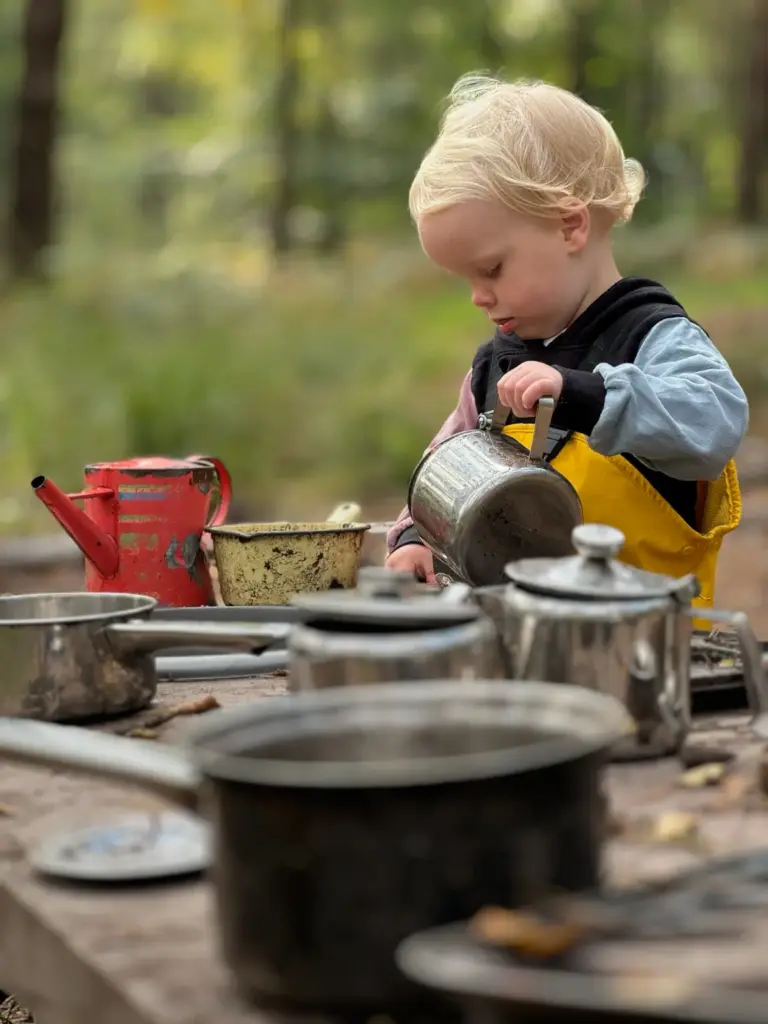
At A Touch of the Wild, we see this kind of curiosity regularly. A planned activity may begin the session, but children will often take their learning in an entirely different direction because they have noticed something unexpected.
That freedom to follow an interest is an important part of Forest School practice. Children have opportunities to investigate, explore and make connections at their own pace. They may become absorbed in building, digging, creating or imaginative play, but alongside that activity they are also becoming increasingly familiar with the natural environment around them.
At Wild Tots, even very young children can begin discovering woodland life alongside their grown-ups. For older children, repeated outdoor experiences can deepen that connection further, encouraging confidence, observation and a greater understanding of the natural world.
We cannot know which children will eventually go on to become ecologists, conservationists, gardeners, scientists or Forest School leaders. Nor does every child need to. The more important aim is to help children grow up feeling comfortable in nature and understanding that it has value.
Raising a generation that notices
Stories about environmental decline can understandably feel overwhelming, particularly when we think about the world today’s children will inherit. That is why projects such as Wild Pets are so encouraging. They remind us that positive change can begin with something very small.
A child becomes fascinated by a tiny animal. That fascination leads to questions. Questions lead to knowledge, and knowledge can lead to action.
Perhaps one of the most important things we can do for the future of the natural world is to give children enough meaningful experiences in nature that they develop their own reasons to care about it.
That might begin with a rare harvest mouse conservation project, but it can just as easily begin with a worm discovered beneath a log, a robin that appears regularly in the garden or the excitement of finding the first frogspawn of spring.
When children are given opportunities to notice nature, learn from it and feel part of it, we give them something that facts alone cannot provide: a personal connection.
And that connection may be where lasting care for the natural world begins.
If you would like your child to spend more time exploring, discovering wildlife and learning outdoors, find out more about Wild Tots, Wildlings Forest Kindergarten and A Touch of the Wild’s woodland experiences in Devon.