September starts with shiny shoes, new backpacks and plenty of excitement.
Then a couple of weeks pass.
Suddenly everyone’s tired.
Morning routines have returned. Children are adjusting to new classrooms, new teachers or childcare settings. Clubs start again. Evenings become busier and the long, relaxed days of summer can feel surprisingly far away.
For young children in particular, September can involve an enormous amount of change.
Which is why this time of year is also a wonderful moment to make space for something much simpler – time outside.
September asks a lot of children
Think about how many things a child might be processing at the beginning of a new term.
Different routines.
New faces.
Busier environments.
More instructions.
New expectations.
Perhaps longer days away from home.
Even positive change requires energy.
That’s one reason children can sometimes seem completely fine all day and then become overwhelmed by something seemingly tiny when they get home.
They’ve simply had a very full day.
Outdoor play gives them a different kind of space.
The woods don’t ask children to hurry
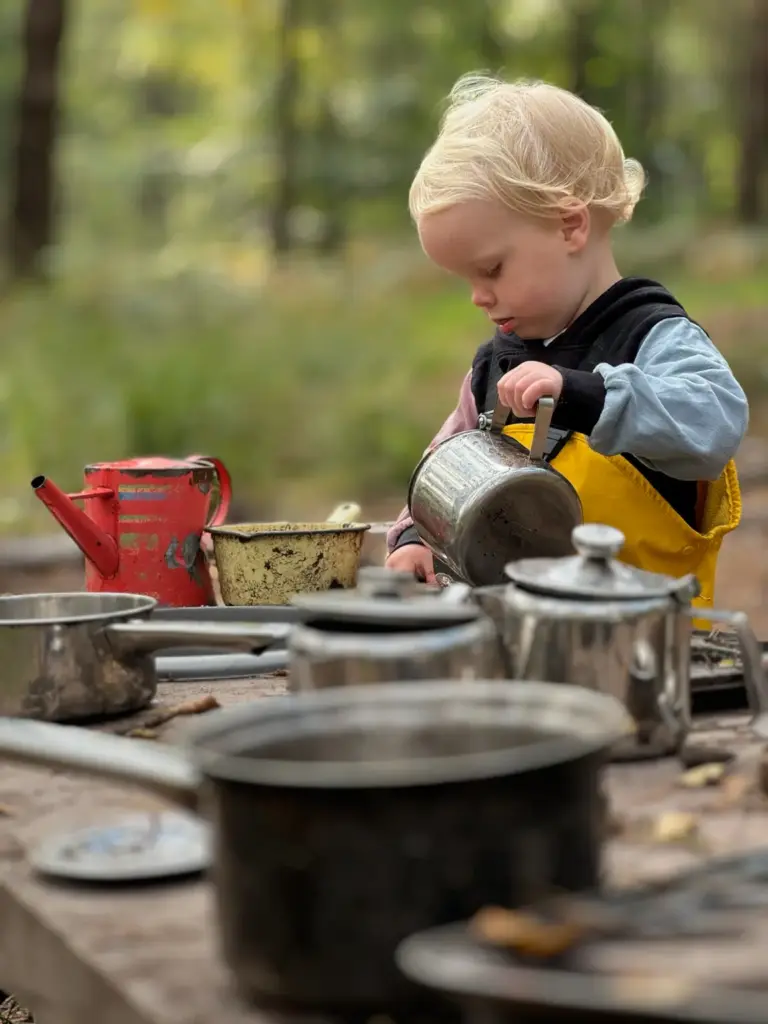
One of the things we love most about Forest School is its pace, there are fascinating things everywhere, but there isn’t pressure to explore them all.
A child might spend half an hour digging one hole, another might sit quietly watching insects beneath a log.
Someone else may run, climb and build until they’re ready for a rest around the campfire.
Forest School is child-led, meaning children have opportunities to follow their interests and engage at their own pace rather than moving continuously between adult-directed activities. That approach is central to the Forest School ethos.
For children experiencing a busy September, that freedom can feel wonderfully different.
Movement matters
Children are designed to move.
Running over uneven ground, balancing along logs, climbing, digging, carrying branches and crouching to investigate bugs involve the whole body.
And there’s a lovely side-effect.
After being asked to sit, listen and follow routines for parts of their day, children get a chance to simply move.
No exercise class required.
Just a woodland and something interesting on the other side of it.
Nature offers a different kind of stimulation
Modern family life can be noisy.
Traffic. Screens. Toys. Music. School corridors. Notifications. Television.
Then you step into the woods.
You hear leaves moving.
Birds calling.
Rain hitting the canopy.
A stick breaking under someone’s welly.
There’s still plenty happening, but it feels different.
Children begin noticing small things.
They investigate.
They become absorbed.
And sometimes they simply stop and watch.
These quieter moments are every bit as valuable as the big adventures.
Autumn gives children something new every week
September also marks one of the most exciting times to be outdoors, the woods are beginning to change.
Leaves slowly shift colour.
Acorns fall.
Conkers appear.
Spiders create extraordinary webs.
Fungi emerge.
The mornings become cooler.
For children who return to the same woodland regularly, these changes become part of an unfolding story.
“What happened to that tree?”
“Where have all these acorns come from?”
“Was that mushroom here last week?”
This is one of the great strengths of regular Forest School experiences: children don’t simply visit nature once. They develop a relationship with a place and experience how it changes throughout the year.
Five easy ways to create a September nature reset
You don’t need an entire forest to bring a little more nature into family life.
Try one of these after nursery or school:
1. Take the long way home
Choose a route with trees, grass or a park and allow an extra ten minutes for wandering.
2. Let them lead
Instead of organising an activity, ask: “Where should we explore?”
You may be surprised where you end up.
3. Start an autumn treasure bowl
Collect fallen leaves, acorns, feathers or other natural finds and create a seasonal collection at home.
Remember not to pick living plants or fungi unnecessarily, fallen treasures are usually more than enough.
4. Go on a tiny nature hunt
Rather than a complicated checklist, look for just three things:
Something red.
Something rough.
Something tiny.
Young children love having a mission.
5. Stay outside when it rains
Pull on waterproofs and go looking for puddles.
September weather in Devon isn’t always predictable, but that is half the fun.
And grown-ups benefit too
Here’s the bit we sometimes forget.
Outdoor time isn’t only good for children.
When we put the phone away, walk beneath trees and watch our children become absorbed in something beautifully ordinary, we get a chance to slow down too.
Sometimes everyone needs the September reset.
A Touch of the Wild’s Wild Tots sessions are designed for children from newborn to five alongside their grown-ups, combining child-led woodland play with seasonal activities, stories, sensory exploration and a campfire snack.
So while your little one explores, there is space for parents and carers to connect too.
Make the woods part of your autumn rhythm
September doesn’t have to mean abandoning the freedom of summer.
We can carry a little of it with us.
Muddy boots after nursery.
A pocket full of conkers.
Ten extra minutes under the trees.
A morning around the campfire.
Because sometimes the thing children need after a busy week isn’t another organised activity.
It’s space to be children.
🍂 Fancy making the forest part of your family’s autumn? Our Wild Tots sessions run throughout the week at our private woodland near Exeter, with Forest School play, seasonal activities and campfire treats for little explorers and their grown-ups.