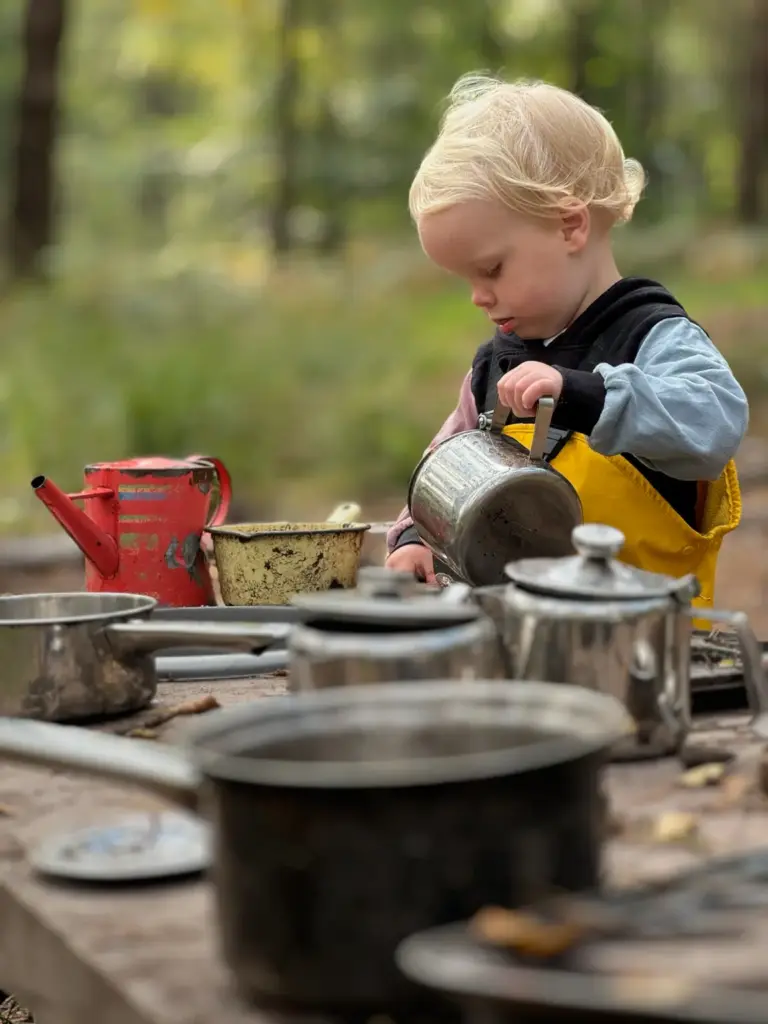
Childhood should be filled with opportunities to explore, imagine, create and play.
Yet family life can be busy. Between nursery, school, organised activities, appointments and screens, children do not always have as much time as they need for simple, child-led play.
National Playday takes place across the UK on Wednesday 5 August 2026, providing the perfect opportunity to celebrate every child’s right to play and consider why free outdoor play matters so much.
At A Touch of the Wild, we believe play is not separate from learning. When children are given time, space and freedom in the woods, they are developing valuable skills that can support them throughout childhood and beyond.
What is National Playday?
Playday is the UK’s national day for play and is celebrated on the first Wednesday in August each year.
It raises awareness of the importance of play in children’s lives and encourages communities, families, schools and early years settings to provide welcoming spaces where children can play freely.
The message is simple but important: play is not merely a way to keep children occupied.
Through play, children discover how the world works, build relationships, test ideas, express their feelings and develop confidence in their own abilities.
What do we mean by free play?
Free play is led by the child rather than directed by an adult.
There is no fixed outcome, complicated set of instructions or single correct way to take part. Children decide what to do, how to do it and how long they wish to remain involved.
In the woods, this might look like:
- Transforming a fallen branch into a pirate ship
- Building a den with friends
- Making a café from mud, leaves and acorns
- Following an interesting insect
- Inventing a woodland obstacle course
- Mixing a magical potion
- Creating a story around a tree stump
- Sitting quietly and watching the world go by
To an adult, some of these activities may appear simple. For the child, however, they can involve imagination, communication, decision-making, movement, negotiation and problem-solving.
Why outdoor play is so valuable
The natural world provides a rich and constantly changing environment for play.
Unlike many manufactured toys, natural materials do not have one prescribed purpose. A stick can become a wand, a spoon, a fishing rod, part of a den or the beginning of an entirely new game.
This flexibility encourages children to use their imaginations.
The woodland also changes from one visit to the next. Rain creates puddles and mud. Wind brings down leaves and twigs. Sunshine reveals butterflies and shadows. Each season introduces different colours, textures, sounds and discoveries.
Children are not simply using the outdoor environment as a backdrop. They are responding to it, learning from it and incorporating it into their play.
Play develops problem-solving skills
Child-led outdoor play often presents children with small, manageable challenges.
How can we stop the den roof from falling down? Is this branch strong enough? How can we carry the log together? What could we use to collect rainwater?
Adults may be tempted to provide the answer immediately. However, when children are given time to test their own ideas, they learn to think creatively and adapt their approach.
A plan may not work the first time. That does not mean the activity has failed.
The process of trying, reconsidering and attempting something different helps children develop patience, persistence and resilience.
These are important foundations for future learning.
Play helps children build friendships
Outdoor play creates many natural opportunities for children to connect with one another.
A group of children building a den must share ideas and decide how to work together. An imaginary woodland game requires them to explain the story, listen to others and agree on roles.
There may occasionally be disagreements, but these moments are also part of learning.
With appropriate adult support, children begin to practise negotiation, compromise, turn-taking and empathy. They discover that other people may have different ideas and learn how to find a way forward together.
Some children find conversation easier when they are engaged in a shared outdoor activity. Collecting sticks, digging in the mud or walking through the woods can take away the pressure of direct conversation and allow friendships to develop naturally.
Play supports children’s physical development
Children need opportunities to move their whole bodies.
In woodland environments, they can climb, balance, crouch, stretch, carry, lift and navigate uneven ground. These movements support strength, coordination, balance and body awareness.
Fine motor skills also develop through activities such as threading natural materials, manipulating small objects, tying, digging and creating woodland crafts.
Most importantly, movement happens for a purpose that is meaningful to the child.
They are not balancing simply because an adult has asked them to practise balance. They may be crossing a pretend river, completing an adventure trail or reaching an important part of their imaginary world.
Play can support emotional wellbeing
Children use play to process their experiences and express feelings that they may not yet have the words to explain.
A woodland environment can also provide space away from noise, pressure and constant stimulation. Some children are drawn to energetic group games, while others prefer to investigate quietly or sit in a familiar spot.
Both are valuable.
Free play allows children to make choices and experience a sense of control. It gives them time to follow their interests without being hurried towards an adult-led outcome.
This freedom can help children feel capable, settled and connected.
Does free play mean adults do nothing?
Child-led play does not mean children are left entirely without guidance or support.
The adult’s role is to create a safe, welcoming environment, observe carefully and recognise when help is genuinely needed.
Sometimes an adult might provide a useful resource, ask a thoughtful question or help children think through a problem. At other times, the most valuable thing they can do is step back and allow the play to continue.
At Forest School, experienced leaders balance freedom with appropriate boundaries. Children have space to explore and make decisions while learning how to care for themselves, one another and the woodland.
Simple ways to encourage outdoor play this summer
Families do not need expensive equipment or elaborate plans to enjoy outdoor play.
Try visiting a familiar green space and allowing your child to choose the activity. Bring a simple container for collecting fallen natural treasures, create a base beneath a tree or see what games emerge from a few sticks and leaves.
Adults can encourage play by offering open-ended prompts such as:
“What do you think we could make?”
“Where do you think this path leads?”
“How could we make that stronger?”
“What have you noticed?”
Try to resist the urge to shape every activity. Children’s ideas may take the experience in an entirely unexpected direction, and that is part of the joy.
Celebrate outdoor play with A Touch of the Wild
National Playday is a wonderful reminder of something children need throughout the year: the time, freedom and space to play.
At A Touch of the Wild, our woodland programmes in Devon give children opportunities to explore nature, follow their curiosity, develop new skills and enjoy genuine outdoor adventures.
Our Wild Tots sessions offer toddlers and their parents or carers a friendly introduction to woodland play.
Our Wildlings Forest Kindergarten provides regular outdoor learning and child-led exploration in a nurturing woodland setting.
During the school holidays, our Woodland Adventure Club gives children time away from screens to make friends, get muddy and create their own woodland memories.
Because when children are given the freedom to play, they are doing far more than passing the time.
They are learning who they are, what they can do and how they belong in the world around them.
Discover A Touch of the Wild’s Forest School sessions and outdoor activities for children in Devon.