What happens when we stop telling children what to do and start listening to what they have to say?
It sounds like a simple question, but it goes to the heart of something incredibly important in early childhood education.
Young children are naturally curious. They ask questions, develop ideas, make discoveries and see possibilities that adults might completely overlook. Given the chance, they can turn an ordinary morning into an extraordinary adventure, often without any instructions at all.
At A Touch of the Wild, here in our beautiful Devon woodland near Exeter, we believe that children deserve to have a voice in their own learning. Their interests, ideas and choices matter, and some of the most meaningful experiences begin when we give them the freedom to lead.
This November, two important national conversations are shining a light on exactly why this matters.
The growing recognition of the power of play
In September 2026, the Forest School Association held its national conference, Embers: The Power of Play, bringing together Forest School practitioners and educators from across the UK.
The conference explored how play, curiosity and child-led experiences shape children’s development, and why protecting opportunities for meaningful play is such an important part of education.
It is a conversation that feels particularly relevant as we approach World Children’s Day on the 20th of November.
This year’s UNICEF theme, My Day, My Rights, My Future, encourages adults to listen to children’s voices and recognise their right to help shape the world around them.
The United Nations Convention on the Rights of the Child recognises both children’s right to express their views and their right to play.
These ideas are closely connected to the Forest School approach, where children are encouraged to explore their interests, make decisions and become active participants in their learning.
But what does child-led learning actually look like?
When children lead, wonderful things can happen
Imagine a group of children heading into the woods for a morning of exploration.
An adult might have planned a leaf-printing activity, but on the way, one child spots an unusual hole beneath a tree.
“Who lives in there?”
Suddenly, everyone is interested.
One child thinks it might be a rabbit. Another suggests a fox. Someone wants to look for footprints, while another begins collecting fallen leaves to create an imaginary home for the mysterious woodland creature.
What began as a simple observation has opened up opportunities for investigation, conversation, teamwork, storytelling and creativity.
There was no worksheet, no predetermined outcome and no need for every child to reach the same conclusion.
The learning developed because the children were genuinely interested.
This is the beauty of child-led learning. Rather than following a rigid plan, children can explore questions that matter to them, with experienced adults supporting and extending their discoveries.
Developing confidence through everyday choices
For young children, having opportunities to make decisions can be incredibly empowering.
A child who chooses which materials to use for a woodland creation is practising decision-making.
Two children deciding how to build a shelter are learning to listen, negotiate and consider different ideas.
A child who decides to try balancing along a fallen log, with appropriate adult support, is learning to assess a challenge and recognise their growing abilities.
These moments might appear small, but they give children valuable opportunities to develop independence and confidence.
They also help children understand that their opinions matter.
When an adult genuinely listens to a child’s idea, takes their question seriously or allows them time to work something out, the message is powerful:
Your thoughts are important. Your ideas are worth exploring. You are capable of contributing.
That sense of being valued can support children’s confidence, relationships and willingness to try new things.
The important role of adults in child-led learning
Of course, child-led learning doesn’t mean allowing children to do absolutely anything they want.
Quite the opposite.
High-quality Forest School experiences depend on knowledgeable, attentive adults who understand how to balance freedom with appropriate boundaries, safety and support.
Sometimes the most valuable thing an adult can do is observe.
Rather than immediately stepping in with an answer, we might ask:
“What do you think will happen?”
“How could we make that work?”
“What would you like to try next?”
Other times, children need reassurance, practical help or a gentle suggestion to help them move forward.
The important thing is recognising when to guide and when to give children space.
At our Wildlings Forest Kindergarten, qualified early years practitioners and experienced Forest School leaders support children as they explore the woodland, develop relationships and follow their interests.
Activities such as natural crafts, storytelling and outdoor exploration provide opportunities for children to make meaningful choices while feeling safe, supported and encouraged.
Not every child expresses their ideas in the same way
Listening to children means much more than simply asking them questions.
Some children confidently announce exactly what they want to do. Others express themselves through actions, gestures, facial expressions or the activities they return to again and again.
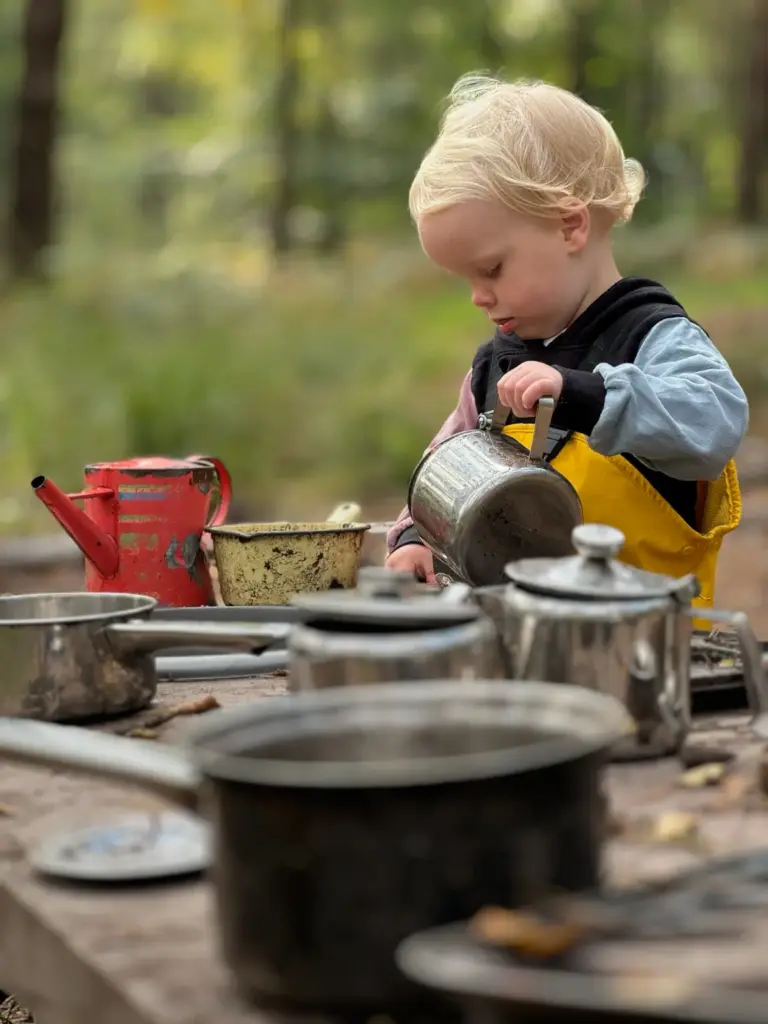
A child who repeatedly visits the mud kitchen might be fascinated by pouring and mixing.
Another who spends ages watching insects might be developing a deep interest in living things.
A quieter child may prefer to observe an activity before feeling ready to join in.
These are all forms of communication worth noticing.
Child-led learning is not about expecting every child to be outgoing or outspoken. It is about recognising each child’s individual personality, interests and ways of engaging with the world.
And the woodland offers a wonderful variety of opportunities for different children to discover where they feel most comfortable.
Three simple ways to encourage child-led learning at home
You don’t need a forest on your doorstep to give children more ownership over their play.
Small changes to everyday routines can make a difference.
1. Let your child choose the adventure
On your next outdoor walk, try allowing your child to lead the way somewhere safe. Perhaps they want to investigate a puddle, examine a tree or spend ten minutes watching a snail.
You might not travel very far, but you could discover something wonderful together.
2. Ask questions without rushing to provide answers
If your child wonders why leaves change colour or how worms move underground, resist the temptation to explain everything immediately.
Ask what they think. Encourage them to investigate. Sometimes the process of discovering an answer is just as valuable as the answer itself.
3. Make space for uninterrupted play
Children don’t always need an organised activity.
A few natural materials, an interesting outdoor space and time to experiment can be enough to spark wonderful imaginative play.
Allowing children to become absorbed in something they have chosen for themselves can be a valuable gift.
Giving children the freedom to grow at Wildlings Forest Kindergarten
At A Touch of the Wild, we have been sharing the magic of outdoor learning with Devon families since 2005.
Our approach is rooted in the belief that children learn best when they feel secure, valued and free to explore.
At Wildlings Forest Kindergarten, children aged 2½ to 5 enjoy a nurturing, nature-based alternative to traditional nursery, surrounded by the changing seasons and endless possibilities of our private woodland near Exeter.
With qualified early years practitioners, experienced Forest School leaders and a child-led approach, children have opportunities to build confidence, develop friendships and discover the joy of learning through real experiences.
As World Children’s Day reminds us, listening to children is not simply a nice thing to do. It is an important part of respecting who they are.
And sometimes, one of the most powerful things we can say to a child is:
“That’s an interesting idea. Shall we see where it takes us?”
Discover Wildlings Forest Kindergarten
If you’re looking for an early years setting where your child’s curiosity, confidence and individuality are genuinely valued, we’d love to introduce you to Wildlings.
Find out more about Wildlings Forest Kindergarten and how to register.