If you’ve ever emptied your child’s pockets and discovered three acorns, a feather, six stones and a particularly important-looking stick, you’re not alone.
To adults, a stick might simply be a stick.
To a child, however, it could be a wand, a fishing rod, a spoon, a dragon, a bridge, a tool, a flagpole or the final essential piece of a den that absolutely cannot be left behind.
And this seemingly simple kind of play is doing far more for children’s development than we might realise.
At A Touch of the Wild, we see it every day in our Devon woodland.
Children rarely need us to tell them how to play in nature. Give them time, freedom and an interesting environment and they’ll very quickly find something worth investigating.
The magic of open-ended play
One of the wonderful things about natural materials is that they don’t come with instructions.
A plastic toy may already have a defined purpose.
A stick doesn’t.
That means children have to decide what it is going to become.
Today it might be part of a den. Tomorrow it could be used to draw pictures in the mud. Five minutes later it might become a musical instrument.
That freedom encourages children to use imagination, creativity and problem-solving skills and because there isn’t necessarily a ‘right’ answer, children are free to experiment.
That pile of sticks is actually problem-solving
Imagine a group of children building a den, they soon discover that the longest branch is too heavy, another branch keeps falling over.
There’s a gap in the roof.
One child has an idea, another disagrees and somebody else discovers a completely different solution, without sitting down for a formal lesson, those children are practising:
- communication
- teamwork
- negotiation
- planning
- spatial awareness
- perseverance
- problem-solving.
And perhaps most importantly, they’re motivated to keep trying because the project belongs to them. At Forest School, learning often happens because children genuinely want to solve the problem in front of them.
Mud is surprisingly educational
Then there’s mud.
Wonderful, squelchy, irresistible mud.
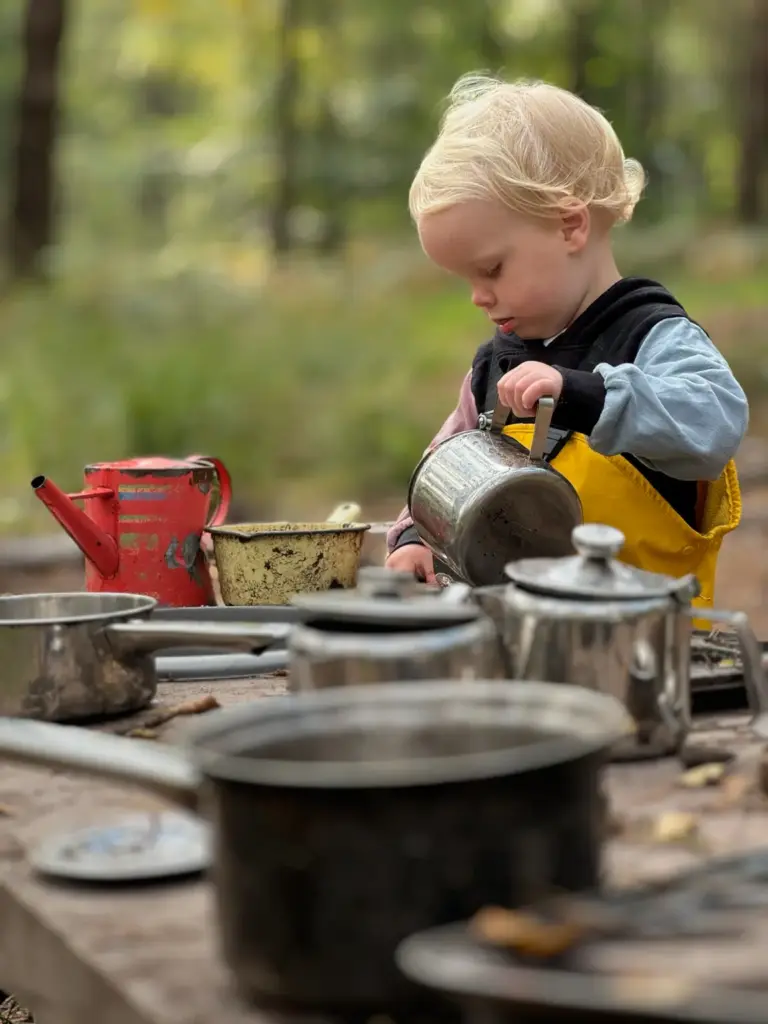
A mud kitchen might look like nothing more than children making endless bowls of brown soup, but look a little closer.
Children may be measuring, pouring, mixing and experimenting with different textures, they’re learning what happens when water is added to soil. They’re deciding whether their mixture needs another handful of leaves.
They’re sharing bowls, negotiating roles and inventing stories.
They’re strengthening the muscles in their hands as they scoop, stir and squeeze, muscles they’ll later use for skills such as writing and fastening clothes.
That’s a lot of learning from one very muddy bowl of imaginary soup.
Nature encourages children to notice things
Spend time with a young child in the woods and you’ll quickly discover how much they notice.
A tiny snail.
A feather caught between two leaves.
A spider’s web covered in droplets.
A hole in a tree.
A mushroom that definitely wasn’t there last week.
Regular time outdoors gives children opportunities to observe changes and ask questions.
Why is that leaf red?
Where do worms go when the ground is dry?
What made that footprint?
Why does this piece of bark feel different?
We don’t always need to provide the answer immediately.
Sometimes the most valuable part is allowing children to wonder.
Curiosity is where learning begins.
Why children collect natural treasures
And what about those pockets full of acorns? Collecting is another surprisingly rich childhood activity, children sort objects by size, shape and colour, they compare them, count them, swap them and arrange them.
One child’s collection of conkers can suddenly become an informal maths lesson without anyone announcing that it is ‘maths time’.
More importantly, the collection matters because the child chose it.
When children feel ownership over their discoveries, they are much more likely to become deeply engaged.
Learning to judge risk
Forest School also gives children opportunities to encounter manageable challenges.
Should I climb onto that log?
Can I balance all the way across?
Is this branch strong enough?
Can I carry this by myself?
Experienced Forest School practitioners don’t simply remove every challenge from children’s environment. Instead, we support children to begin understanding their own abilities and making increasingly thoughtful decisions.
Over time, children begin to recognise what feels comfortable, when they need help and when they’re ready to try something new.
This supported risk-taking is a core part of the Forest School approach at A Touch of the Wild.
And sometimes… play is simply play
As adults, we often feel the need to justify children’s activities by explaining what they’re learning.
But there’s another important point.
Children are allowed to play simply because playing is part of childhood, not every muddy puddle needs a learning objective, not every den needs an educational outcome.
Sometimes jumping in the puddle because it makes an enormous splash is reason enough.
Ironically, when children are given that freedom, an extraordinary amount of learning often happens anyway.
Come and see learning in the wild
At A Touch of the Wild, our woodland near Exeter gives children the time and space to explore, experiment, create and follow their curiosity.
Our Wild Tots sessions introduce little explorers and their grown-ups to nature play, sensory activities, crafts, stories and campfire adventures, while Wildlings Forest Kindergarten provides children aged 2½-5 with an immersive Forest School experience.
So next time your child proudly hands you a very ordinary-looking stick and insists you take it home…
You might want to keep it.
Apparently, it’s important.
🌿 Curious about Forest School? Come and experience A Touch of the Wild in our beautiful private woodland near Exeter. Discover Wild Tots or arrange a visit to Wildlings Forest Kindergarten.