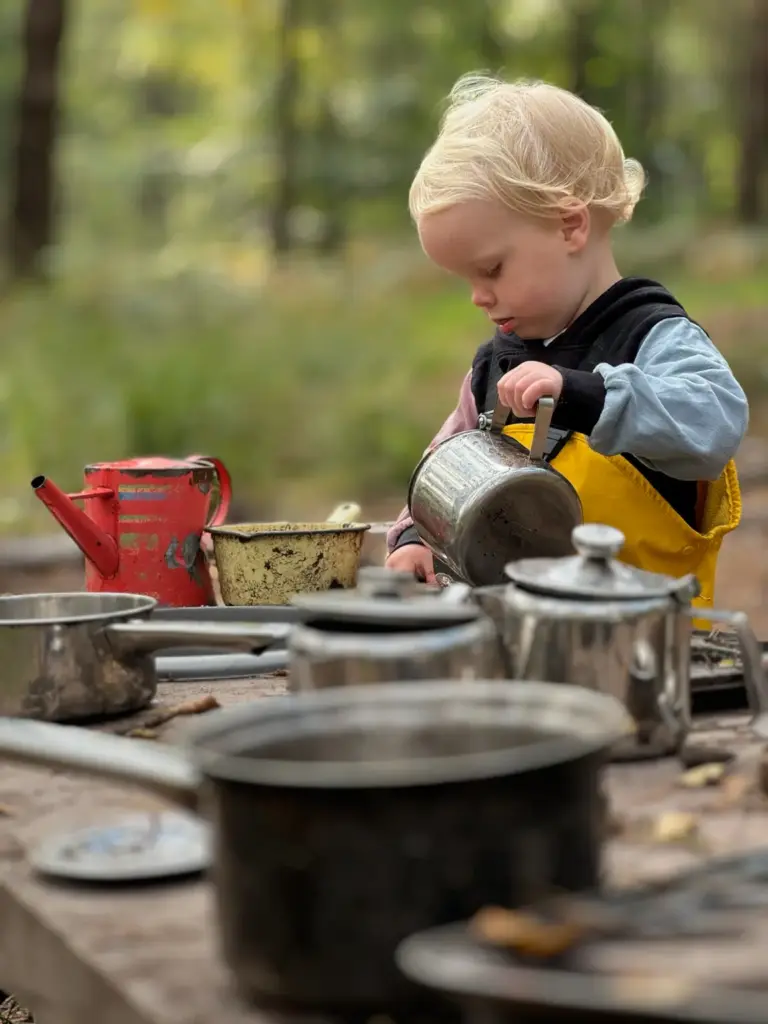
Could regular outdoor learning soon become part of every child’s school week?
A new Outdoor Education Bill introduced in Parliament on 7 July 2026 has sparked an important national conversation about how much time children spend learning, playing and exploring outside.
The proposed Bill calls for children in primary and secondary education to spend at least 30 minutes outdoors during the school day. It also proposes a minimum of one outdoor lesson each week, alongside outdoor education experiences during both primary and secondary school.
The Bill is still at an early stage and has not become law. However, its introduction highlights something that Forest School practitioners, teachers and many parents have understood for years: outdoor learning is not an optional extra. It can be a valuable part of a child’s education, development and wellbeing.
Here in Devon, we are fortunate to be surrounded by woodlands, green spaces and wonderfully varied natural environments. At A Touch of the Wild, we see every day how learning outdoors can help children become more confident, curious, resilient and connected to the world around them.
Outdoor learning is real learning
When people imagine outdoor education, they sometimes picture children simply running around and getting muddy.
There may well be plenty of running and mud involved, but there is also a great deal of meaningful learning taking place.
A woodland can become a rich and exciting classroom.
Children can explore early mathematics by counting sticks, comparing natural objects, spotting patterns and measuring the ingredients used in campfire cooking. They can develop communication and literacy skills by sharing stories, following instructions, learning new vocabulary and describing what they discover.
Science is happening all around them as they examine minibeasts, observe the changing seasons, investigate plants and learn about woodland habitats.
Outdoor learning can also encourage children to ask their own questions.
Why is this leaf changing colour? Where do worms go when the ground is dry? What will make our den stronger? How can we light a fire safely?
These moments of natural curiosity can lead to powerful learning because children are actively involved in the experience.
Children learn through movement and exploration
Young children are naturally active learners. They often understand ideas more easily when they can move, touch, build, test and explore.
In the woods, learning is not restricted to sitting at a table. Children can carry branches, balance on logs, mix mud, search beneath leaves, build shelters and work together to solve practical problems.
These experiences support physical development, coordination and spatial awareness. They also give children opportunities to test their abilities and discover what their bodies can do.
A child who carefully balances across a log is learning to assess distance, control their movement and manage an appropriate level of risk.
A group building a den must communicate, share ideas and adapt when the first design does not work.
The learning is practical, memorable and meaningful.
Outdoor education builds confidence and resilience
Not every activity works perfectly the first time.
A den may collapse. A knot may come undone. A fire may take several attempts to light. A carefully balanced tower of sticks may tumble to the ground.
In a supportive outdoor environment, these moments are not treated as failures. They are opportunities to pause, reconsider and try again.
This helps children develop resilience and persistence.
Rather than immediately solving every problem for them, experienced Forest School leaders give children the time and encouragement to explore possible solutions. Children begin to understand that mistakes are part of learning and that they are capable of overcoming challenges.
That quiet sense of achievement can be incredibly powerful.
The child who initially says, “I can’t do it,” may later be the one proudly showing someone else how it is done.
Taking appropriate risks helps children grow
It is natural for parents and carers to want to protect children from danger. However, children also need opportunities to experience carefully managed, age-appropriate risk.
At Forest School, risk is not ignored. It is understood, assessed and supported.
Depending on their age and stage of development, children might learn how to use simple tools, move safely around a campfire, climb, balance or explore uneven ground.
These activities help them develop judgement and awareness.
When children are given the chance to consider a challenge, make decisions and recognise their own limits, they can become more capable and confident. They learn how to approach risk thoughtfully rather than simply avoiding every uncertain situation.
These are skills they can carry into many other areas of life.
The woodland offers space for different kinds of learners
Traditional classroom environments work well for many children, but some children find it easier to participate and express themselves outside.
The open space and changing natural environment can offer different ways to become involved. A child who is reluctant to speak in a large group may begin a conversation while collecting sticks with a friend. Another may demonstrate patience and concentration while creating something with natural materials.
Outdoor learning gives children opportunities to succeed in many different ways.
There is space for the energetic explorer, the careful observer, the imaginative storyteller, the practical problem-solver and the child who needs a little more time before joining in.
A good Forest School environment does not expect every child to experience the woodland in exactly the same way.
Regular experiences create deeper connections
A single outdoor activity can be enjoyable, but regular time in nature offers something deeper.
When children return to the same woodland throughout the year, they begin to notice small changes. They see new leaves emerging, watch flowers appear, experience rain on the canopy and discover how the forest floor changes with the seasons.
The woodland becomes familiar while always offering something new.
Children develop a sense of belonging and begin to form a genuine relationship with the natural world. They learn that nature is not simply a topic in a book or somewhere they visit occasionally. It is something they are part of.
This connection matters.
Children who know and care about the natural world are more likely to want to look after it. By helping children develop a love of nature, outdoor education can encourage the environmental awareness that future generations will need.
Why outdoor learning matters in Devon
Devon provides an extraordinary setting for outdoor education. Our woodlands, countryside and wildlife give children countless opportunities to explore and learn.
The introduction of the Outdoor Education Bill by a South Devon MP also makes this national discussion particularly relevant to local families.
It presents an opportunity for Devon to show what high-quality outdoor education can look like.
At A Touch of the Wild, outdoor learning has always been at the heart of what we do. Our sessions are designed to give children the freedom to explore while being supported by knowledgeable and experienced leaders.
From making woodland crafts and discovering wildlife to building dens, cooking around the campfire and developing new friendships, every experience can contribute to a child’s learning and development.
Giving children more time to be children
Modern family life can be busy. Children’s days are often filled with structured activities, indoor environments and digital distractions.
Time in the woods offers a chance to slow down.
It gives children room to use their imaginations, follow their interests and become absorbed in play without needing a screen to direct the experience.
A stick can become a wand, a fishing rod, a tool or part of an elaborate woodland shelter. A fallen tree can become a pirate ship, a meeting place or a challenging balancing route.
This kind of open-ended play is not wasted time. It supports creativity, collaboration, independence and problem-solving.
Most importantly, it gives children the freedom to experience the joy of being outdoors.
Discover outdoor learning with A Touch of the Wild
Whether outdoor learning eventually becomes a formal part of every school week remains to be seen. The Outdoor Education Bill is currently only a proposal and must progress through Parliament before it could become law.
However, the conversation it has started is an important one.
Every child deserves opportunities to explore nature, take appropriate risks, develop confidence and discover that learning can happen far beyond the classroom walls.
At A Touch of the Wild, children and families can experience the benefits of outdoor learning through our nature-based programmes in Devon.
Our Wildlings Forest Kindergarten provides regular woodland experiences where young children can learn, play and grow in a nurturing outdoor environment.
Our Wild Tots sessions introduce younger children and their parents or carers to the magic of the woods through seasonal play, exploration and shared adventures.
During the school holidays, our Woodland Adventure Club gives children the opportunity to enjoy exciting outdoor activities, make friends and create wonderful woodland memories.
Outdoor education may be receiving national attention, but here in Devon, children are already discovering what can happen when the woodland becomes their classroom.